Become part of the Canadian visual arts community
2025 Featured Artist
Lee Richard
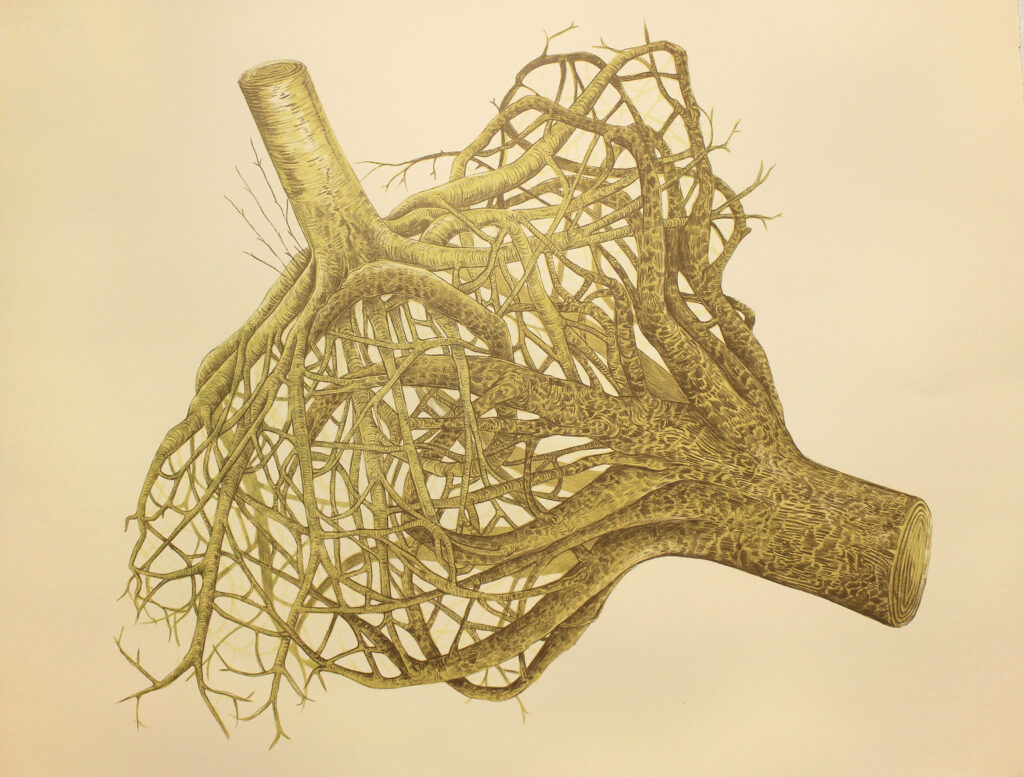
Anastomosis, 2025@Lee Richard
Lee Richard’s love for printmaking began with his first lithograph, a portrait of his cat, Ollie. What started as a way to learn the process of drawing on polished limestone quickly evolved into a passion. The print, featuring Ollie with five pairs of eyes, human-like arms, and a floating shiny crown, marked the beginning of a love for printmaking. Originally from Prince Edward Island, Lee draws inspiration from the landscapes of his childhood, including farms, woodlands, and red beaches. Lee’s dedication to printmaking is rooted in his love for the labour-intensive process, which has honed his patience and deepened his commitment to the craft. Lee Richard is a recent NSCAD graduate living in Halifax, NS.
Anastomosis Statement:
“I have always been drawn to trees. My family taught me to cherish them, and today, as an artist, they continue to hold my gaze. In February 2024, my friends and I trekked into the woods. The four of us shared a small off-grid cabin in Hall’s Harbour and a profound affection for the forest. Each day we hiked through -30 degree weather, engaging with the forest, scanning for the sublime. A pair of trees uprooted in a storm kept bringing me back. Their roots tangled underground, one taking the other down as it fell. I sat in the snow studying them, my hands freezing as I drew. I gave them stories in my head: they were rivals who fought each other to their mutual demise, they were lovers in their death throes, choosing to be together forever. Back in the cabin, my mind lingered on their fused limbs. I imagined them becoming one, anastomosing. In biology, anastomosis is a connection that transfers information and nutrients between otherwise divergent structures. For plants and fungi, this often occurs underground, with whole forests communicating through mycelium. These two connected intimately, their personal exchanges violently exposed by environmental destruction.
I created this work on paper using photoplate and limestone lithography plant fibre, metal, and stone ripped from the ground. My process in transcribing these trees’ emotive qualities was meditative, allowing me to further engage with the narratives gathered from their image. As I processed my drawing and printed each layer, their stories only read louder. The physical exertion needed to produce a lithograph deepened my feelings for these trees. I was allowed to spend long hours rendering their image, determining and mixing my coloured inks, and processing each of the four layers onto photo plates and polished stones. Finally, the elation of pulling each print off the matrix, revealing the final layer, brought me the satisfaction of knowing I had captured the love and dismay I saw in them that day, as I sat in the snow. “
MANY THANKS TO OUR INSTITUTIONAL ASSOCIATES















Many thanks to our Partners